• Home
  • About
  • Books
  • Blog
  • Contact
Subscribe
fb-logo
  • Home
  • About
  • Books
  • Blog
  • Contact

Blog

Whence What with Whom?

April 25, 2026 | Post a comment

In other words, where do my titles come from?

I usually know the title of a novel before I start writing it, and Arsenic with Austen was no exception. I’m always a fan of alliteration, so pairing a death-related word with the name of the classic author du jour (du roman?) was a no-brainer. And since we’re playing off initial letters, why not go alphabetical? Especially since Austen starts with A.

Jane Austen, Charlotte Brontë, Fyodor Dostoevsky, E. M. Forster, Victor Hugo, Henry James

The inimitable Jane Austen is the first alphabetically and also the first in my personal catalog of greats. She was not only a pioneer as a female author, but she was the first writer of either gender to perfect the novel form as we know it today. Her wit and incisive characterizations are as on-point today as they were 200 years ago.

The Brontës were an obvious choice for B. Honestly, although I played off it to some extent in Bloodstains with Brontë, Wuthering Heights annoys me to no end. Its structure is all over the place, its protagonists are mad, bad, and socially unacceptable, and there’s no redemption in it for anyone. But Jane Eyre, which I also used, is one of the greatest novels in the English language. It’s the first time we get an intimate, unvarnished look into a female mind whose goal is not first romance and marriage but independence and self-respect. Romance and marriage come as a reward for long suffering.

Whom could I pick for C but the queen of crime, Agatha Christie? She gave me so much to work with that writing Cyanide with Christie was great fun from beginning to end. If you want an amusing parlor game, go through it and count the Christie tropes—beginning with a bunch of strangers trapped in an isolated country house by bad weather.

Dostoevsky was my first choice for D, but my initial (American) publisher didn’t think he was cozy enough. I started on a Dickens-themed novel, but halfway in my American publisher dropped the series, and it was picked up by a British house who had no problem with tormented Russian authors. So I switched gears and wrote about the great Fyodor Mikhailovich instead. As a proto-psychologist extraordinaire and the author of two of the first great murder mysteries, Crime and Punishment and The Brothers Karamazov, he provided plenty of material. And I got to put my degree in Russian literature to some use after all these years.

The pandemic hit as I was beginning work on what would have been Execution with Eliot. But I was so stressed out in 2020 that I couldn’t bear to be immersed in George Eliot’s rather grim and depressing novels. So I jumped forward in the alphabet to Fatality with Forster. I love E. M. Forster for his sly wit, his wonderful characters, and his quiet rebellion against the rigid and stifling social structures of his time. I had visited Oxfordshire in 2019, and it made the perfect setting both for Forster and for Luke & Emily’s disappointingly (to them) but unsurprisingly (to us) not corpse-free honeymoon.

I skipped G for the simple reason that I couldn’t think of an appropriate author who was well known enough for a book to work. So it was on to H.

Victor Hugo’s masterpiece, Les Misérables, proved to be fertile ground for a murder mystery with its larger-than-life characters and dramatic plot. In addition, the novel is among the most powerful explorations of forgiveness and redemption ever written—and forgiveness and redemption are among my favorite themes. Next to Cyanide with Christie, Hanging with Hugo probably makes the most explicit use of the source author’s material of all the books in the series.

What do all these authors have in common? Perhaps only two things: They are outstanding craftspeople with the English (or Russian or French) language. And they know human nature deeply and believe it to be redeemable.

Labels: Books

Why Crime with the Classics?

April 25, 2026 | Post a comment

But first—Unboxing!

In a minute, I’ll talk about my inspiration for Crime with the Classics. But first I have something else to share with you. Yesterday (eight days before expected) I received my first box of author copies of JUSTICE WITH JAMES. Honestly, it was almost as exciting as the first box of ARSENIC WITH AUSTEN, which was the first novel I had published.

I didn’t have three hands or a videographer handy, so you’ll have to settle for still shots. Just picture me wildly excited as I’m taking them.

Except for the professional cover design I paid for (and of course the printing and binding), I made this book all by myself. Not usually the way I do things, but I’m glad to have done it this once. And I’m pretty happy with the result.

The Inspiration for Crime with the Classics

Now, on to more serious matters. The idea for the Crime with the Classics series came to me in 2012 or ’13, after The Ghostwriter had made the rounds of editors who liked the story but couldn’t see a place for it in their lists. I’d been writing seriously for about eight or nine years by then, and I was getting tired of being rejected—not because my writing wasn’t good enough, but as the Brits say, because my face didn’t fit.

I thought about the novels I liked to read and realized they fell predominantly into two groups: classics and mysteries. At the top of my mystery list were a group of women writers from the British Golden Age whom I affectionately refer to as “my dead Englishwomen”: Dorothy L. Sayers, Ngaio Marsh, Margery Allingham, Patricia Wentworth, Agatha Christie, and Josephine Tey. I also came to love some contemporary writers, including the best-selling Louise Penny and Jacqueline Winspear. Mysteries, I realized, were popular. They sold. People made actual money writing them.

At the same time, I had been hearing an increasing (and worrying) number of aspiring writers confess that they didn’t read the classics. How could one become a decent writer without reading the classics? How could one even be a truly thoughtful and critical reader without that background?

So the light bulb went on: I would write a series of traditional mysteries* that somehow incorporated the classics as well. I could satisfy readers like myself who loved both categories. Maybe I could even inspire some people to begin reading them who hadn’t done so before.

I started assembling elements of series I had either wished for or enjoyed in the past, both in books and TV:

  • A small-town setting with a series cast of quirky characters
  • A dose of humor to balance serious situations
  • Lots of literary allusions
  • A middle-aged female protagonist
  • A dash of romance
  • A local lawman who was neither hostile nor an idiot
  • A literary angle (but not a bookshop or library, because those are overdone)
  • A setting where a steady stream of visitors or temporary residents is plausible (because you don’t want to kill off or lock up all the townspeople)

I poured all those ingredients into my magic cauldron, recited a few arcane spells, and came up with a widowed literature professor who inherits a mansion in a small coastal town and reconnects with her teenage sweetheart, who is now the local sheriff. She uses her knowledge of literature to bring a new perspective to the characters and situations involved in the (naturally) statistically improbable number of murders that occur in her immediate vicinity. I would theme each book around a different classic author, basing my titles on alliteration and alphabetical order to achieve the requisite cleverness.

And Crime with the Classics was born.

*This series is often classed as “cozy,” a label I don’t much care for because it suggests fluffy mass-market paperbacks with cartoonish covers focused on crafts, cooking, or pets. I prefer “traditional” because it harks back to my dead Englishwomen, who were much more serious writers. But my books do meet the basic criteria for a cozy, which include an amateur sleuth, no or only mild profanity, and no graphic violence or sex.

Labels: Books

The James Connection

April 25, 2026 | Post a comment

Henry James, that is

As you may have gathered, each volume of Crime with the Classics is themed around a different classic author. Sometimes the connections are strong, sometimes subtle. They may center on characters, themes, plot elements, or a general mood.

If you’ve read any Henry James, you’ll know that one thing you can never count on with him is a happy ending. Don’t worry—that’s not a characteristic I drew on in writing Justice with James. Traditional mysteries demand happy endings, and this one won’t disappoint.

What I’m primarily playing off here is James’s ghost stories. The most famous of these is The Turn of the Screw, but he wrote a number of others as well. The ghostly presences manifest in a wide variety of ways in the different stories, but there’s one common thread: The ghost (or other supernatural phenomenon) tends to target one character in particular with a very specific agenda. It could be revenge, it could be seduction, it could be protection, it could be a sort of passing on of a torch. You’ll have to read Justice with James to find out what our ghost’s agenda is and whether she accomplishes it.

Labels: Books

Crime with the Classics: The series so far

April 25, 2026 | Post a comment

In case you haven’t been following the series from the beginning, here’s a little background:

In Arsenic with Austen, widowed Emily Cavanaugh’s great aunt Beatrice leaves her a Victorian mansion, a fat bank account, and half the real estate in the (fictional) Oregon coastal town of Stony Beach. Emily’s return to the setting of her childhood summer vacations also brings the return of her first love, Lieutenant Sheriff Luke Richards. As they work together to uncover the real story behind Beatrice’s death, Emily and Luke rekindle their thirty-year-old romance, and Emily decides to retire from her college teaching job and relocate to Stony Beach permanently.

Unaccustomed to and uncomfortable with her newfound wealth, Emily determines to turn her mansion, Windy Corner, into an invitation-only retreat center for writers, with each bedroom themed around a different classic author. She hires a local teenage single mother, Katie, as housekeeper, and Emily’s friend and colleague Marguerite helps to recruit the guests.

But to Emily’s dismay, over the course of the following months (and novels), Windy Corner and Stony Beach become the sites of a series of troubling murders, each of which brings to Emily’s mind some connection with a classic author. She uses this knowledge to help Luke bring the murderers to justice.

The series moves to Emily’s old college in Portland for Death with Dostoevsky, then to Oxfordshire for Luke and Emily’s honeymoon in Fatality with Forster, then back home to Stony Beach in Hanging with Hugo.

(In case you’re curious about the alpha order, there is no “E” book because the pandemic hit at that time and was so stressful I couldn’t face writing a book themed around the rather doleful George Eliot. “I” was going to be a tongue-in-cheek short story called “Iocaine with Ionescu,” but I never got around to writing it.)

You can find the previous volumes of the series at your favorite online retailer, or order them from your local bricks-and-mortar store, or request signed copies from me.

Labels: Books

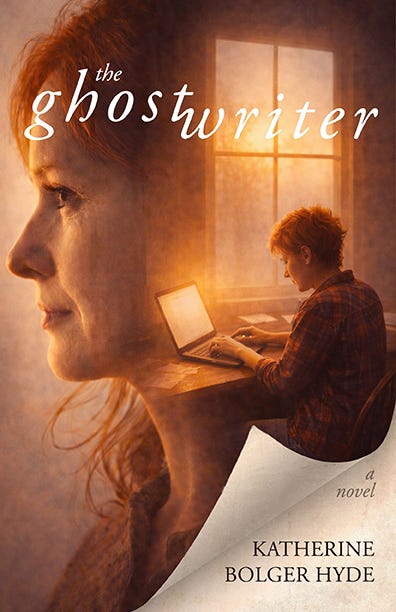
Cover reveal—THE GHOSTWRITER

April 25, 2026 | Post a comment

My current traditional publishing endeavor is ready for pre-order!

Maeve O’Shaughnessy has been writing novels to great critical acclaim for twenty years without ever making a public appearance. But when her publisher insists she begin promoting her own books, Maeve, a recluse with anxiety disorder, cannot face such a terrifying ordeal. Instead, she recruits her identical twin, Margaret, to be her public persona.

Despite her misgivings, Margaret—recently divorced and in need of income—agrees. Problems quickly arise, from being recognized by acquaintances to falling in love with a man who hero-worships Maeve. With every talk or book signing, the line between her own identity and her sister’s blurs a little more. When Maeve is critically injured in a car accident, Margaret faces the most harrowing decision of all: Will she continue to live as Maeve, or will she take possession of her own life and become the woman she was always meant to be?


This is a book about sisters, about twins, about love and family and loss, about finding your true identity. It’s for everyone who has ever lost herself in caring for other people. It’s for every writer who has ever wished for a clone to do publicity for her. It’s for my sister, the extrovert in the family, who has always taken care of me (though I’m not as dysfunctional as Maeve, by a long shot—I hope!).

For all my Santa Cruz County and Bay Area friends, it’s also a book about living in our little corner of the West Coast. And it’s a book about faith, in a subtle way, as personified by the character of Fr. Sergius, Margaret’s lodger who becomes her friend and unofficial spiritual adviser. He seems to be everyone’s favorite character, though he wasn’t part of my original plan for the book (that happens a lot). I hope you will love him too.

I wrote this book back in 2010 or thereabouts, before I took a pause on writing this kind of fiction (whatever this kind is) and started writing salable mysteries. Various publishers liked it but didn’t think it fit their niche. I’m grateful it’s finally found a niche with Chrism Press.

Labels: Books, Publishing

I Did a Thing

April 25, 2026 | Post a comment

A new thing. A kind of scary thing.

Over the last couple of weeks, I’ve been doing a thing I’ve never done before. I’m preparing to self-publish—or, as we in the industry prefer to say, indie publish—a novel.

To many authors, this is nothing momentous; in fact, it’s their norm. But I’ve always been prejudiced in favor of traditional publishing, despite its many drawbacks, for several reasons:

  1. Passing the gatekeepers validates me as a writer. If an agent thinks enough of my books to take me on as a client (thank you, Kimberley Cameron!), and if an acquiring editor thinks enough of a manuscript to champion it, and if a whole committee thinks enough of it to offer me a contract, I know at least the book won’t make my friends and relations embarrassed to know me.
  2. I have a team behind me in the production process. Every publisher I’ve worked with has had good editors, skilled designers, publicity & marketing people lending their professional efforts to launch my book into the world. I may not have always been completely delighted with every aspect of the process, but at least I didn’t have to do it myself, and I believe in the power of collaboration enough to be confident that the totality of the end result is better than I could have produced on my own.
  3. I can leave the pros to get on with it while I go on to write another book. Yes, there’s always stuff for the author to do—reviewing edits and proofs, answering questionnaires, the dreaded promotional phase—but fundamentally, the ball is in someone else’s court. I know all too well from the experience of the last few months how distracting it is to have several books in various phases of the process at once. Some people can happily multitask to that extent, but I am not one of them.
  4. Some amount of money is more or less guaranteed to come in. Most of my novels have been sold for an advance, and even those that were contracted “on spec,” as it were, have sold or will sell to at least some portion of the publisher’s established customer base. The royalties may be pitifully low, but they do arrive. With my new venture, despite the higher royalty percentage, I can’t be sure I’ll make back the money I’ve invested in cover design and production expenses.
  5. My books can appear on bookstore shelves without my having to buttonhole bookstore buyers and beg. And I get to say, “I’ve been published by _____.” There’s still a little bit of prestige attached to that, for the time being, at least.

So why did I decide to test the indie waters with this upcoming book, Justice with James?

Because it’s the seventh and final volume of a series. The previous publisher didn’t like the sales numbers of my last few books, so they weren’t willing to take this one on. No other publisher in their right mind would take on the last volume of an orphaned series. (And you know I wouldn’t want one who was out of his wits.) But the book was completed before I knew it would be orphaned, and I believe there are a few fans of the series out there who would be happy to visit with Luke and Emily one last time.

So Justice with James will hit the virtual shelves of Amazon on April 15, when all my Orthodox friends have had a couple of days to recover from Pascha.

If you’re a writer trying to decide which publishing path to pursue, please don’t take my experience as normative. For many people, indie publishing is absolutely the best way to go. You have control over every aspect, you keep all the rights to your work to exploit any way you want, and you get a much bigger piece of the pie.

The only drawback is that you have to bake the pie yourself. And I’ve never been much of a baker.

Labels: Books, Publishing, Writing

Why Read the Best Fiction?

April 25, 2026 | Post a comment

Once again, we need to begin with definitions.
I am not talking about the distinction between “literary” and “commercial” or “genre” fiction. For one thing, I think these categories are largely artificial, ill-defined, and subject to change. For example, we consider the novels of Charles Dickens to be classic literature today, but in his time his work was highly commercial. And the best fiction of any genre transcends that genre to become, simply, great literature.
When I talk about “the best” fiction, I’m referring to works of any genre, any category, that are well written and in some way original (there’s nothing entirely new under the sun, but some books make you forget that). These works make you think, have significant themes and content, and have either stood the test of time or have a fair chance of doing so. They resonate with your deepest self and stay with you in a good way, causing you to ponder their characters and meanings long after you’ve finished reading. They enrich your life.

Fiction that does not make that grade in my personal scale may be poorly written (or just mediocre), fluffy, predictable, shallow, with a plot that is more wish fulfillment than timeless truth. It may leave no lasting impression, or it may leave you with a bad taste in your mouth or even with mental/spiritual indigestion. It can make you dissatisfied with a life that is less exciting than those of its two-dimensional characters.

Of course, we all want a little mindless comfort reading now and then, just as we all enjoy the occasional piece of candy or junk-food snack. But if you try to survive on junk food alone, you’ll soon find yourself very ill indeed. You need a steady diet of good nutritious food.

The problem is that too much salt, fat, and sugar not only don’t nourish you well but can ruin your taste for veggies and lean protein. Similarly, too much junky fiction can be addictive and ruin your taste for the good stuff. Our minds and bodies are naturally inclined toward laziness and taking the easy way. If we let them take it too often, we forget how wonderfully exhilarating a meal of fully realized characters in a compelling setting facing genuinely significant choices, with just the right seasoning of captivating prose and deeper meaning, can be.

The best fiction, like the best food, gives us strength for the journey of life. It elevates both mind and spirit and trains us to appreciate true beauty—in the arts, in nature, and most importantly, on the spiritual plane. The best fiction embodies ultimate truth, whether or not it has any deliberate spiritual orientation. Instead of the false hope of wish fulfillment, which lasts only as long as the reading, the best fiction gives us real and lasting hope for eternal redemption.

Labels: Reading

Why Read Inspirational Fiction?

April 25, 2026 | Post a comment

Before I embark on a discussion of inspirational fiction, let’s define some terms. I am NOT talking about the kind of novels that resemble sermon illustrations or “clean” romance novels with a moral thrown in. These are not art but stories recruited to serve the practical purpose of evangelism.

What I mean by inspirational fiction is literary art informed by the immanent presence of God in the world. Works of writers like Elizabeth Goudge, Fyodor Dostoevsky, Flannery O’Connor. Fiction that I call, borrowing a phrase from the last writer in this list, “God-haunted.”

Christians who are leery of reading fiction often feel that way because they don’t know there is fiction out there that expresses their worldview. They care about literary quality, but they don’t want to read novels that see the world only in shades of gray with no real good or evil; that ignore true beauty in favor of mere sensual gratification; that sensationalize crime, abuse, sex, and violence, the more horrific the better; that assume readers share a nihilistic worldview in which our actions don’t matter because there is no God and no afterlife and we’ll all feed the worms in the end.

But this, dear reader, does not sum up the totality of contemporary fiction. They aren’t easy to find, but novels and stories do exist that are both beautiful and true; that believe in the nobility of the human spirit; that show us plainly the eternal battle between good and evil and the truth that good will ultimately triumph; that reaffirm the possibility of healing and redemption, even from the lowest depths humanity can sink to.

Reading books like these allows us to enjoy the consolation of story while obeying St. Paul’s exhortation in Philippians 4:8: “Whatever things are true, whatever things are noble, whatever things are just, whatever things are pure, whatever things are lovely, whatever things are of good report, if there is any virtue and if there is anything praiseworthy—meditate on these things.”

Where do you find such fiction? It abounded in previous centuries, but it is also still being published today. Look at the offerings of Wood Between Worlds Press; Paraclete Press; a few titles from Ancient Faith Publishing; Ignatius Press; Chrism Press. Look to authors like Marilynne Robinson, Leif Enger, Bret Lott, Mark Helprin, Rumer Godden, Edith Pargeter/Ellis Peters, Walker Percy, Graham Greene, Madeleine L’Engle, Susan Howatch, Nicholas Kotar.

Read any of these and you will feel the refreshing breath of paradise wash over you. Few of us can subsist on a rigorous diet of only scripture and spiritual instruction. Give yourself permission to relax a bit and let God speak to you through the eternal voice of story.

Labels: Reading

Why Read Fiction?

April 25, 2026 | Post a comment

The art and creative pastime of reading fiction is on the wane in our society. A number of factors contribute to this; I think we all know what they are, so I won’t waste time talking about the causes. Instead, I want to remind us all (yes, including myself; I don’t read nearly as much as I used to) of why reading fiction—at least, the right kind of fiction—is not merely entertaining but good for the soul.

Fiction expands the mind

Fiction can take us to times and places we’ve never been, perhaps can never go. It shows us worlds, whether real or imagined, that cast a different light on the world we live in. Fiction is better at this than nonfiction because it invites us to enter into the experience of characters living in the other world: we see through their eyes, hear through their ears, touch, taste, and smell with their sense organs, process information through the lens of their cultural context. We come to understand far more than our own limited lives can show us. History comes alive; its lessons hit home in a way they never can in a classroom.

Fiction cultivates empathy

Closely related to the above, fiction cultivates empathy. As we view the world through the eyes of people whose lives are quite different from our own, we paradoxically come to understand how very alike we all are in spite of that. Differences in gender, ethnicity, religion, social class, or anything else don’t reach far below the skin. If you prick us, we all bleed red. We all share substantially the same hopes and fears. We are all human beings made in the image of God. In our increasingly insular, xenophobic society, this understanding is crucial to our mutual survival.

Fiction makes hard truths palatable

People often dismiss fiction as made-up, un-factual, and therefore useless. But good fiction has its own kind of truth—a truth that can cut much deeper than mere facts. Fiction takes the reality we see around us and transforms it, through the deep magic of art, into a stage on which the truths of human nature and of God’s providence become more evident than they often are in life. We can’t always see the big picture in which good triumphs over evil, but in the best fiction, that picture is painted at a size we can perceive. We can’t always see clearly the battle between good and evil in our own hearts, but fiction can hold up a mirror that shows us the uncomfortable truths about ourselves that we’d rather ignore—while also showing us the way to redemption.

Fiction provides a respite from real life

The best fiction is not necessarily escapist in the sense that you can dip into it, forget the real world for a while, and fantasize yourself into the kind of life you wish you had. That kind of escapism isn’t great for the soul because it lulls us into complacency instead of encouraging us to grow. But good fiction does provide what J.R.R. Tolkien referred to as consolation: the balm for the soul that comes from briefly inhabiting a world perhaps more beautiful than our own, where good triumphs and justice prevails—a world that bears, however faintly, the scent of paradise. No one can struggle forever without hope. Good fiction reminds us that hope is not an illusion.

All good stories tell the one universal story

Finally (for this introductory essay), all good stories retell the one eternal story of God’s immeasurable love and humankind’s redemption. The unnamed prince of fairy tales like Snow White and Sleeping Beauty is Christ in disguise; the rescued princess is every woman and man who embraces Him and accepts this rescue. Every hero or heroine is on a journey to discover the divine in some form and bring it back to enrich the whole community. Whatever good things reward the protagonist who perseveres to the end are ultimately sent from God. This can be true even in spite of the author’s intentions, as long as he or she has not completely turned away from the Good, the Beautiful, and the True.

In future posts, I’ll go more deeply into some specific whys of reading fiction. In the meantime, tell me about the good things fiction has done in your life.

Labels: Reading

A New Direction

September 23, 2025 | Post a comment

It’s a long time since I posted on this blog. I’ve been using other means—a very sporadic newsletter, occasional Substack posts, and Facebook—to keep in touch with my readers. Over the coming months, I’ll be making a concerted effort to make my communication with you more focused, frequent, and consistent, but I expect to be using Substack as my primary means of reaching out. Please find me there at https://katherinebolgerhyde.substack.com/.

The last couple of years have seen big changes in my life on all levels—personal, professional, and writing. My husband retired and had heart surgery. We moved from our long-time home in California to Vancouver, Washington, to conserve our limited resources and to be near our daughters and four (soon to be five!) grandchildren. I retired after thirty years as an editor with Ancient Faith Publishing, though I’m still doing freelance editing and coaching part-time.

My writing/publishing life has also seen big changes. After two standalones and six volumes of Crime with the Classics, Severn House decided my sales numbers did not justify their doing any more of my books. And Ancient Faith, which had brought out my novel THE VESTIBULE OF HEAVEN as well as several children’s books, concluded that adult fiction in general wasn’t working for them. Suddenly my unpublished novels were poor little orphans left begging in the snow, with no one to take them in.

So I’m currently testing out a couple of new publishing directions. My previously published YA fantasy, THE DOME-SINGER OF FALENDA, is part of a successful Kickstarter run by Wood between the Worlds Press and will soon be reissued with a new cover and a new hardcover edition. I’m planning to publish the final volume of Crime with the Classics, JUSTICE WITH JAMES, through a Kickstarter of my own (stay tuned!). And the other orphaned novel, THE GHOSTWRITER, has been picked up by Chrism Press and is due to come out in August 2026. A recently completed novel, THE THIN PLACE, is waiting in the wings to see which of these new publishing avenues will be best for it.

In a sense, I’m going in new directions in terms of content as well. Or it might be more accurate to say that I’m returning to the direction of my early work, before I started writing Crime with the Classics: faith-based fiction. THE VESTIBULE OF HEAVEN, THE DOME-SINGER OF FALENDA, and THE GHOSTWRITER were all written before I first tried my hand at mystery, and all three embody my Orthodox faith in more explicit ways than the series does. THE THIN PLACE returns to those roots. The new historical mystery series I’m just beginning to write incorporates the faith element—integral to the society of 14th-century England—in the genre that’s built my career so far. I hope it will appeal to lovers of sacramental fiction as well as to mystery fans.

Don’t be alarmed when I speak of faith-based fiction. This is not the squeaky-clean, in-your-face type of “Christian fiction” that may have left a bad taste in your mouth if you’ve ever tried it, but fiction that faces the real world head-on and insists that it can be redeemed. That goodness is still relevant. That truth can be upheld. That beauty can be found.

This is the direction you can expect to find in everything that comes from my pen in the years to come. It may take the form of YA fantasy, contemporary fiction, historical mystery, or who-knows-what-else, but at the back of it will always be the fundamental assertion that Beauty will save the world.

I hope you, my loyal readers, will follow me in my various new directions. Your input is always welcome. Godspeed to you all, and happy reading!

Labels: Books, Publishing, Writing

  • 1
  • 2
  • 3
  • …
  • 5
  • Next Page »

Archives

Categories

Recent Posts

  • Whence What with Whom?
  • Why Crime with the Classics?
  • The James Connection

Copyright © Katherine Bolger Hyde. Designed by Shaila Abdullah