• Home
  • About
  • Books
  • Blog
  • Contact
Subscribe
fb-logo
  • Home
  • About
  • Books
  • Blog
  • Contact

I Did a Thing

April 25, 2026 | Post a comment

A new thing. A kind of scary thing.

Over the last couple of weeks, I’ve been doing a thing I’ve never done before. I’m preparing to self-publish—or, as we in the industry prefer to say, indie publish—a novel.

To many authors, this is nothing momentous; in fact, it’s their norm. But I’ve always been prejudiced in favor of traditional publishing, despite its many drawbacks, for several reasons:

  1. Passing the gatekeepers validates me as a writer. If an agent thinks enough of my books to take me on as a client (thank you, Kimberley Cameron!), and if an acquiring editor thinks enough of a manuscript to champion it, and if a whole committee thinks enough of it to offer me a contract, I know at least the book won’t make my friends and relations embarrassed to know me.
  2. I have a team behind me in the production process. Every publisher I’ve worked with has had good editors, skilled designers, publicity & marketing people lending their professional efforts to launch my book into the world. I may not have always been completely delighted with every aspect of the process, but at least I didn’t have to do it myself, and I believe in the power of collaboration enough to be confident that the totality of the end result is better than I could have produced on my own.
  3. I can leave the pros to get on with it while I go on to write another book. Yes, there’s always stuff for the author to do—reviewing edits and proofs, answering questionnaires, the dreaded promotional phase—but fundamentally, the ball is in someone else’s court. I know all too well from the experience of the last few months how distracting it is to have several books in various phases of the process at once. Some people can happily multitask to that extent, but I am not one of them.
  4. Some amount of money is more or less guaranteed to come in. Most of my novels have been sold for an advance, and even those that were contracted “on spec,” as it were, have sold or will sell to at least some portion of the publisher’s established customer base. The royalties may be pitifully low, but they do arrive. With my new venture, despite the higher royalty percentage, I can’t be sure I’ll make back the money I’ve invested in cover design and production expenses.
  5. My books can appear on bookstore shelves without my having to buttonhole bookstore buyers and beg. And I get to say, “I’ve been published by _____.” There’s still a little bit of prestige attached to that, for the time being, at least.

So why did I decide to test the indie waters with this upcoming book, Justice with James?

Because it’s the seventh and final volume of a series. The previous publisher didn’t like the sales numbers of my last few books, so they weren’t willing to take this one on. No other publisher in their right mind would take on the last volume of an orphaned series. (And you know I wouldn’t want one who was out of his wits.) But the book was completed before I knew it would be orphaned, and I believe there are a few fans of the series out there who would be happy to visit with Luke and Emily one last time.

So Justice with James will hit the virtual shelves of Amazon on April 15, when all my Orthodox friends have had a couple of days to recover from Pascha.

If you’re a writer trying to decide which publishing path to pursue, please don’t take my experience as normative. For many people, indie publishing is absolutely the best way to go. You have control over every aspect, you keep all the rights to your work to exploit any way you want, and you get a much bigger piece of the pie.

The only drawback is that you have to bake the pie yourself. And I’ve never been much of a baker.

Labels: Books, Publishing, Writing

A New Direction

September 23, 2025 | Post a comment

It’s a long time since I posted on this blog. I’ve been using other means—a very sporadic newsletter, occasional Substack posts, and Facebook—to keep in touch with my readers. Over the coming months, I’ll be making a concerted effort to make my communication with you more focused, frequent, and consistent, but I expect to be using Substack as my primary means of reaching out. Please find me there at https://katherinebolgerhyde.substack.com/.

The last couple of years have seen big changes in my life on all levels—personal, professional, and writing. My husband retired and had heart surgery. We moved from our long-time home in California to Vancouver, Washington, to conserve our limited resources and to be near our daughters and four (soon to be five!) grandchildren. I retired after thirty years as an editor with Ancient Faith Publishing, though I’m still doing freelance editing and coaching part-time.

My writing/publishing life has also seen big changes. After two standalones and six volumes of Crime with the Classics, Severn House decided my sales numbers did not justify their doing any more of my books. And Ancient Faith, which had brought out my novel THE VESTIBULE OF HEAVEN as well as several children’s books, concluded that adult fiction in general wasn’t working for them. Suddenly my unpublished novels were poor little orphans left begging in the snow, with no one to take them in.

So I’m currently testing out a couple of new publishing directions. My previously published YA fantasy, THE DOME-SINGER OF FALENDA, is part of a successful Kickstarter run by Wood between the Worlds Press and will soon be reissued with a new cover and a new hardcover edition. I’m planning to publish the final volume of Crime with the Classics, JUSTICE WITH JAMES, through a Kickstarter of my own (stay tuned!). And the other orphaned novel, THE GHOSTWRITER, has been picked up by Chrism Press and is due to come out in August 2026. A recently completed novel, THE THIN PLACE, is waiting in the wings to see which of these new publishing avenues will be best for it.

In a sense, I’m going in new directions in terms of content as well. Or it might be more accurate to say that I’m returning to the direction of my early work, before I started writing Crime with the Classics: faith-based fiction. THE VESTIBULE OF HEAVEN, THE DOME-SINGER OF FALENDA, and THE GHOSTWRITER were all written before I first tried my hand at mystery, and all three embody my Orthodox faith in more explicit ways than the series does. THE THIN PLACE returns to those roots. The new historical mystery series I’m just beginning to write incorporates the faith element—integral to the society of 14th-century England—in the genre that’s built my career so far. I hope it will appeal to lovers of sacramental fiction as well as to mystery fans.

Don’t be alarmed when I speak of faith-based fiction. This is not the squeaky-clean, in-your-face type of “Christian fiction” that may have left a bad taste in your mouth if you’ve ever tried it, but fiction that faces the real world head-on and insists that it can be redeemed. That goodness is still relevant. That truth can be upheld. That beauty can be found.

This is the direction you can expect to find in everything that comes from my pen in the years to come. It may take the form of YA fantasy, contemporary fiction, historical mystery, or who-knows-what-else, but at the back of it will always be the fundamental assertion that Beauty will save the world.

I hope you, my loyal readers, will follow me in my various new directions. Your input is always welcome. Godspeed to you all, and happy reading!

Labels: Books, Publishing, Writing

Crossing the Pond

April 28, 2018 | 11 Comments

If you know me at all or have read my books, you’ve probably guessed I’m an anglophile. And a pretty rabid one, at that. In my view, the Brits do almost everything better, from TV to accents to cottages to cheese. A glance at my book and DVD collections reveals that my content consumption is heavily weighted toward the UK, so it’s no surprise that, as one friend recently commented, I write with a British accent.
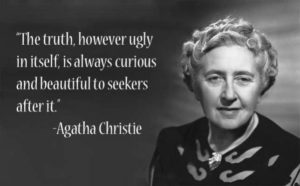
So when my agent, Kimberley Cameron, suggested shopping my orphaned series to a British publisher, I was intrigued. I looked up Severn House online and discovered that they publish in both the UK and the US and market their books to the entire English-speaking world. They actually specialize in picking up orphaned series and mid-list authors—neither of which most US publishers will touch. They’ve been around for over forty years and have more than 600 titles in print, so this is no tiny fly-by-night press. I started to get excited.

Kimberly had me put together a package including the full manuscript of Cyanide with Christie (third volume in the Crime with the Classics series), descriptions of the first two books, and the first chapter and synopsis of the proposed fourth. Within a week of sending this package to Severn, she received an enthusiastic response. They were interested provided I could tighten up the mystery a bit. At this point my response ratcheted up to thrilled.
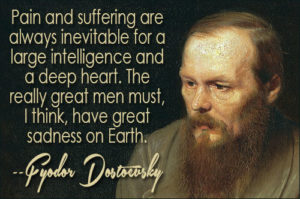
I did the requested revisions quickly and sent them off, and within another week we had an offer. A wee bit of tweaking and we were ready to proceed to contract. And before that week was out, I had the contract in my inbox. (Contrast this with four months from offer to contract in the case of my original publisher.) Cyanide with Christie is planned to release in November 2018 and Death with Dostoevsky about a year after that. (Contrast this with two years from contract to first book published and 17 months between books 1 and 2.) Now you can color me ECSTATIC.

The contract is signed and in the mail. I look forward to working with a publisher that is responsive, fast, enthusiastic, unafraid of highbrow subject matter (e.g. Dostoevsky), and committed to making my books the best they can be. The fact that Severn House is located in London—and I may have an excuse to visit their offices one day—is pure gravy. Or, shall we say, hard sauce on the plum pudding.

Cheers, mate! I’m crossing the pond!

Labels: Books, Writing

12 Secrets to Writing a Great Novel

March 19, 2016 | 2 Comments

Hint: There are no secrets to writing a great novel. But there are some things you need to know.

This post is a slightly grumpy response to the myriads of posts/ads I’ve seen lately offering to help you write a bestselling book in nothing flat. They make me wish English had no generic word such as book that can apply equally to any set of bound pages (or bytes of equivalent length), regardless of category, genre, or quality. Fortunately, we do have a specific word for book-length works of fiction: novel.

The shortcuts I’m referring to (at least, the ones presented in good faith, such as Michael Hyatt’s current offering)* might work fine for writing a nonfiction book, especially if it’s something connected with your business or area of expertise. But when it comes to writing a novel . . .

  1. There are no shortcuts.
  2. It’s hard. (Yes, it can be fun, but that doesn’t make it less hard.)
  3. It isn’t something everyone can do. You DO need education, training, talent, and lots and lots of practice. (According to Ray Bradbury, about a million words’ worth of practice.)
  4. It’s part of a tradition. If you haven’t been reading great novelists voraciously since childhood, you should probably drop everything and do that for the next twenty years. Then you might be ready to start writing.
  5. It isn’t quick. Despite the popularity of National Novel Writing Month, it is extremely rare that anyone is able to produce a complete, polished novel in 30 days. A year is closer to the norm.
  6. It isn’t formulaic. As W. Somerset Maugham said, “There are three rules for writing a novel. Unfortunately, no one knows what they are.”
  7. It’s a lifelong commitment. A career. A vocation. It isn’t something any sane person would do “just for fun” or to check it off a bucket list. Before you finish one novel, the next one should be percolating in your subconscious.
  8. It’s individual. You can read all you want about other writers’ processes, habits, and journeys to publication, but ultimately, your process, habits, and journey will be uniquely your own.
  9. It isn’t a vehicle for a message. It’s art. You need to have something to say, but if you can express that something in a neat little sentence or paragraph, you should be writing nonfiction, not a novel. Art is more about asking questions than answering them.
  10. It isn’t a solo process. Writing itself is solitary—too solitary for some. But once you finish a draft, you’ll need critiquers and beta readers, and these people should not be your spouse, mother, best friend, or the English teacher who praised your writing in high school—unless those people happen to be publishing professionals or readers of extraordinary perspicacity and frankness. You’ll need cheerleaders and mentors and writing buddies to make it through the process. Ultimately, to publish, you’ll need agents, editors, designers, publicists, marketers, and readers as well.
  11. It’s all about quality. If you send your novel to dozens of agents and/or editors and it repeatedly gets rejected, the best response is to revise, revise, and revise again—not immediately to default to self-publishing. (Self-publishing is fine once you have objective testimony that your novel is the best it can be. It just shouldn’t be a substitute for doing the work to get it there.)
  12. It’s doable. If you persevere despite numbers 1–11 and complete a polished novel, you will have achieved something a great many people dream of doing but relatively few actually accomplish. You will have joined the Eternal Worldwide Brother-Sisterhood of Novelists, which is a really great group to belong to—whether your novel ever reaches a bestseller list or not. Congratulations and welcome to the club!
*Be careful, because there are lots and lots of such “services” that are not presented in good faith. They’re simply out to take advantage of people who want to achieve fame and fortune with minimal effort. Michael Hyatt and anyone he endorses can be relied on to offer integrity and genuine value. (No, I was not paid for this endorsement.)

Labels: Writing

Attitude of Gratitude for Writers

February 5, 2016 | 8 Comments

happy-writerA wonderful man who was once my parish priest, Fr. Gordon Walker, lived by the motto, “You’ve got to have an attitude of gratitude.” That’s something I’ve always struggled with maintaining from day to day, but I’m growing more and more convinced it is absolutely key—not only to the spiritual life, but to life as a writer.

I haven’t actually tried this, but I’m willing to bet if you Google “writing life” or some similar phrase, you’ll come up with about 99 hits that focus on the difficulties of said life for every one that focuses on the positives. You’ll hear about how lonely life is as a writer, how emotionally wrenching, how thankless to slave away day after day with only the remotest hope of publication. And as for financial success, you can forget about that right now. Unless you’re Stephen King or J. K. Rowling, you’re doomed to work for pennies for the rest of your life. You’ll be warned that unless you have a vocation to rival Mother Teresa’s, you’d best stay away.

And yes, writing can be lonely, wrenching, and thankless. It is most certainly hard work. And I would agree writing is not for the faint of heart and not for anyone who can imagine a life without it.

BUT.

People finish novels—good ones—every day. People get published, even traditionally, every day. People get advance checks and royalty checks every day. Writers are out there making a respectable living every single day.

What’s to stop you being one of them?

Possibly your attitude.

I firmly believe we can affect the events of our lives—even those that appear to be beyond our control—through our attitude. If you are convinced you will never be published, never make a living as a writer, there’s an excellent chance that you won’t. You won’t be motivated to put in the excruciatingly long and difficult apprenticeship required of any artist. You won’t see the point of building a network of writing and reading friends. You won’t project the kind of positive attitude that makes people want to be around you, want to help you, and ultimately want to represent or publish you. Eventually, even your muse will shun you out of sheer disgust.

You’ll be digging your own literary grave.

But if you approach your writing career with gratitude for every opportunity, with hope and conviction that you can and will succeed (however you define success), you will put in those hours. You will pursue those friends, you will give back to the writing community, you will create an atmosphere of positivity around you that will draw people and make them want to help you, represent you, publish you, and ultimately, buy and read your books. Your muse will curl up on your desk and purr like a contented cat, and ideas will abound. Every little gain will lead to more gains, whether artistic, financial, or in the simple satisfaction of living the life you love.

It all starts with gratitude.

Why not try an experiment? Begin each day by listing five things you’re thankful for. If you’re struggling, you can start with things like air and water and life itself. Your family and friends. The roof over your head, the clothes on your back, the coffee in your mug.

Then move on to being thankful for the gift and the drive within you that pushes you to write. The opportunity—even if you’ve had to wrest it violently out of adverse circumstances—to sit down and write. The people who support you, if you have some. The experiences of your life, good and bad, that have given you material for writing and made you the person you are, with your own unique vision. The writers who have gone before you and inspired you. The tools you have for writing, whether paper and pen or computer or charcoal on birch bark. The time. The ideas. The words.

Once you start being thankful, it can get kind of addictive. And what’s really addictive is starting each day, each writing session, with a feeling of hope, of excitement, of joy. It will spill over onto your page, and your writing will take on a new luster. You’ll be on your way to becoming the best writer you can be.

And who knows? Once upon a time, Stephen King and J. K. Rowling were struggling in poverty and obscurity just like everybody else. The wheel of fame and fortune could spin your way just as it did for them. You could be one of the lucky ones.

But for now, you are one of the blessed ones. One of those anointed to create. Go forth and be thankful for it.

Labels: Writing

Chosen by a House

May 17, 2013 | 14 Comments

Wisteria Cottage front

A few years ago, I fell in love with a house. It was just like love at first sight for a human being—the kind of instantaneous, unreasoning wallop that has reduced many a better writer than I to clichés. It caught me off guard; it took my breath away; it floored me.

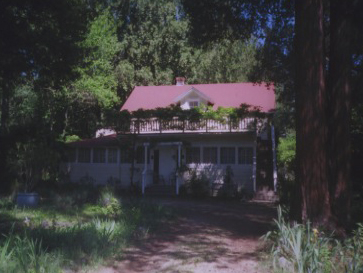
I’d admired the house from afar for years. It sits well back from the road in a charming if overgrown garden just around the corner from my home. The pale yellow siding, low gabled roof, and riotous garlands of wisteria twining the balcony railing pegged it as a “homey house,” the kind I felt I’d like to know better if I ever got the chance.

My chance came when I saw by the driveway first a “for sale” sign, then a sign announcing an open house. I dragged my husband from his Sunday paper and my son from his play, and we walked around the corner to see the house.

Wisteria Cottage side

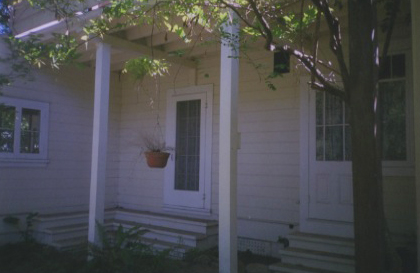
A sign on the front door said in stern letters, “Do Not Open,” and directed all visitors to the kitchen door on the side. I climbed the few steps to the side porch, walked in the kitchen door, and started to cry.

I still don’t know why. The house simply opened its arms to me like a loving grandmother, and I laid my homesick head on her ample bosom and wept.

There was no logic at all behind this reaction. The house did not remind me of any of the places that felt like home to me in my youth—neither my grandmother’s shingled split-level with its wide lawn sloping down to the Chesapeake Bay, nor my great-aunts’ Victorian townhouse full of high ceilings and polished mahogany. Nor did it boast many of the features I’ve always considered mandatory in my dream house: where the fireplace should have been, an ugly gas heater squatted on the sealed brick hearth, and no tower or window seat was to be seen. Not only did the staircase not rise grandly from an open foyer, but the house had no foyer at all and the staircase was on the outside.

Further inspection and questioning revealed that the house—built in the twenties and never remodeled—had major structural problems as well. My husband and I lacked the time, talents, and resources to restore an old house; therefore, my dream home would come ready equipped with a good strong foundation under the weathered pine floors, computer-friendly wiring behind the plaster and beadboard walls, and capacious PVC pipes to feed a steady supply of hot water to the clawfoot tub.

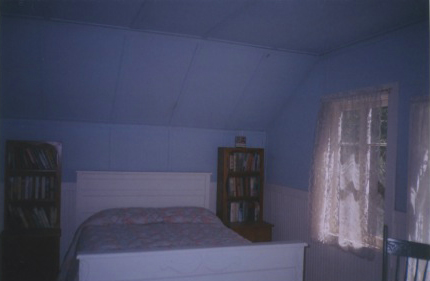
Wisteria Cottage bedroomBut love is blind, and none of these drawbacks made any impression on my affection for the house, which only deepened as I moved from the airy, light-filled living room to the cozy den—just right for a writing room—and on into the warren of tiny rooms at the front of the house, where the precipitous slope of the floor provided a clear explanation for the “Do Not Open” sign on the front door. Upstairs, a blue-and-white bedroom nestled under one gable; I knew my then-twelve-year-old daughter, who could not be dragged from her book to accompany us, would feel just like Anne of Green Gables in that room.

Outside, my son capered across the wooden bridge that arched over the little brook and gazed longingly into the branches of the eminently climbable trees. Dotted about the yard were several tempting spots to linger with a spouse, friend, or good book for companion—one in a rose bower on the east side for coffee in the morning sun, another under the trees by the brook for tea in the afternoon shade.

I walked through the downstairs again, trying to memorize every detail. What was it that called “home” to me so strongly? Surely it had something to do with the deceased owners’ furniture and belongings that still filled the house, untouched. Would the kitchen have been so welcoming if the tall dresser that faced me as I walked in the door had not been filled with brightly colored Fiestaware pitchers and plates? Would the living and dining rooms have seemed so much my own if the ranks of built-in shelves had not been overflowing with gold-stamped hardcover books, if the sideboard had not held hand-tinted photos of the owners’ 1940s wedding in silver filigree frames, if the green nylon plush of the loveseat and chairs had not invited me to sit a spell and chat? I half expected at any moment to see the woman of the house come bustling in from the back porch with a basket of clean laundry, looking just like my Aunt Adee and asking me whether I’d like hot soup or a grilled bacon-and-cheese sandwich for lunch.

We lingered in the garden as other prospective buyers toured the house. I longed for Jedi or wizard-like powers to blind their eyes to the charm of the place, to let them see only the magnitude of the work it needed so they would go away unimpressed, and the ridiculously low offer that was all we could ever afford to make would have no competition. But whatever it was in that house that brought tears to my eyes seemed to affect others almost as strongly. The real estate agent broke gently the news that good offers had already begun to come in.

I sobbed all the way home—not in despair at knowing I could never own the house, but just because seeing it had shaken me to the core. The despair set in gradually over the next few weeks, as a real estate agent friend opened my eyes to the reality of the current market and the cost of restoration. The seller was reportedly impervious to any sentimental approach; my love for the house would not impress him. Not even the cleverest, most devious financing tricks would avail to make that house legally mine. At the end of a month, it was sold.

I pass the house several times a week, and I always check for signs of progress. My great fear was that the new owners would tear it down and rebuild, or gut the house and remodel it into a typical generic modern box. But so far very little seems to have happened. The external appearance of the house is unchanged. No construction crew has trampled the garden coming in to jack up the foundation or replace the roof. Either the new owners are willing to live with the house’s flaws, or they’ve perfected the art of stealth remodeling.

I’m mystified. And since I’ve never seen people there, only a car, I persist in thinking of it as “my house.” I’ve even named it: Wisteria Cottage—a homey, humble, welcoming name.

Perhaps someday the new owners will put the house on the market again, either untouched or restored with a fittingly reverent hand. By that time, perhaps the novel I’ve written, The Vestibule of Heaven—in which the house is not so much a setting as a character—will have become a bestseller, and I’ll have another opportunity to respond to “my” house’s imperious call.

But even if that never happens, I know now what I mean when I say the word “home.”

Labels: Musings, Writing

Why I Write

March 30, 2013 | 5 Comments

This is an essay I wrote as an entry for a conference scholarship. I missed the deadline for the scholarship, but this came from my heart and I’d like to share it with you.

Why Writing Is Important to Me

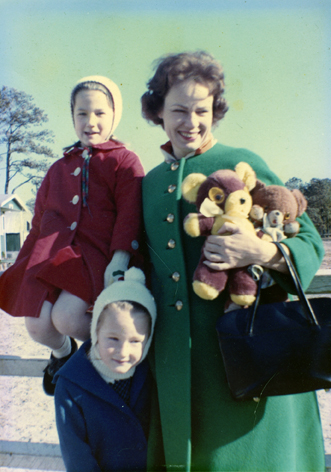
Mama, A, K low res

Me at bottom, with my mother and my sister Anne

As a child, I was invisible. The shy second daughter of a working single mother whose devotion exceeded her energy, I did my best to leave the smallest possible footprint on the world.

As an adolescent, I was misunderstood—not by my parents, but by my peers. They mistook introversion for arrogance and assumed my preference for intellectual pursuits equaled disdain for the pursuits of others. I wrote for myself alone.

As a young mother in a difficult marriage, I was lost. My voice was drowned by the demands of children and a husband absorbed in his own needs. I tried to write, but with no encouragement, I soon gave up.

As an older mother with a second family, now in a supportive marriage, I realized at last that my spirit was withering for lack of expression. The only way I could find myself was to pour myself out on the page and watch what took shape. Job and children notwithstanding, I carved out space and time and began to write.

Eight years and four novels later, as a middle-aged woman on the cusp of an empty nest, I have served my apprenticeship. I have honed my craft, persisted through rejection, shared my lessons learned with those just setting out on this daunting but exhilarating road.

I have found my voice. I am ready to be heard. I will not be silenced again.

Labels: Writing

The Next Big Thing

February 27, 2013 | 6 Comments

Today I’m participating in a “blog hop”—sort of like a chain letter for blogs, but without the guilt. I was tagged last week by Susan Cushman (thanks, Susan!), and at the end of this post I’ll tag several other authors, who will post on the same topic next week. Basically, this blog hop gives us all a chance to tell the world about what we’re working on without looking like we set up a blog just to tell the world about what we’re working on.

We’re asked to answer a series of questions, so here goes!

1: What is the working title of your book(s)?

The book I’ve recently finished writing is called The Ghostwriter.

5: What is the one-sentence synopsis of your book? (I moved this question to a more logical place in line.)

Reclusive author Maeve O’Shaughnessy hires her identical twin, Margaret, to be her public persona, but when Maeve goes into a coma, Margaret is in danger of losing her own identity as well.  

2: Where did the idea come from for the book?

Like most authors I know, I hate the idea of doing my own publicity and marketing. (I’ve found I don’t hate the reality quite as much as I hate the idea.) I’m an introvert, which makes it especially hard. But my sister is an extrovert. So I was thinking one day, wouldn’t it be great if I could get Anne to do all the marketing for me, because she would actually enjoy it. I played around with that idea and took it to its logical conclusion, and The Ghostwriter was born.

3: What genre does your book come under?

This is always a tough question for me. It’s sort of commercial literary or book club fiction, with a dash of magical realism.

4: Which actors would you choose to play your characters in a movie rendition?

emma-thompson-2I don’t choose actors to represent my characters as I’m writing; I envision them as faces I’ve never seen. So this is a difficult question to answer, because no actors I know of look at all as I imagine my characters looking. But I could see Emma Thompson—with red hair and an American accent—in the dual role of Maeve/Margaret.

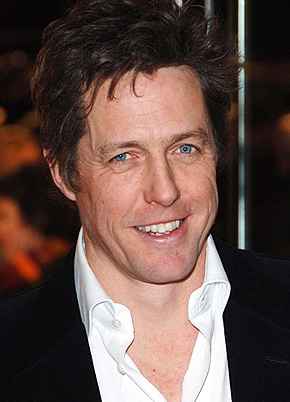
1251305899_hugh_grant_290x402The love interest, Edward, is trickier. If you can imagine a cross between Tom Hanks and Hugh Grant—Tom’s wholesomeness with Hugh’s boyish charm—you’d have something like Edward. Unfortunately they’re both a little old for the part (all these characters are in their mid-40s).

6: Is your book self-published, published by an independent publisher, or represented by an agency?

The Ghostwriter has not been published. I’m represented by Kimberley Cameron, but she hasn’t officially taken on this title yet.

7: How long did it take you to write the first draft of your manuscript?

It took about nine months to write the first draft, with three to six months of concept development and research before that. I read a lot of books about twins.

8: What other books would you compare this story to within your genre?

The book that first comes to mind—the book without which I doubt Ghostwriter would have been written—is The Thirteenth Tale by Diane Setterfield. But other than being about twins with concomitant identity issues, the two books have little in common.

I always have a hard time finding comparables for my novels. The people whose style mine resembles tend to write about different topics; hardly anyone writes about similar topics in a similar way, seemingly. Of the writers I know, I think Susan Cushman may be the most similar to me, but we’re both still awaiting publication.

10: What else about your book might pique the reader’s interest?

I deal with the special connection between identical twins—twin language, telepathy, feeling each other’s pain, and so forth. It’s a fascinating set of phenomena with no satisfactory scientific or even spiritual explanation. I don’t attempt any explanation in the novel, but just sort of take the phenomena for granted, as a natural part of these twins’ lives.

That’s it for me. Next week on March 6, please visit the following blogs to read about these authors’ Next Big Things:

Charise Olson writes what she calls California fiction—”It’s like Southern fiction, but without all the humidity.” In other words, contemporary fiction with a humorous voice but with underlying serious spiritual and emotional issues.

Bev. Cooke writes a variety of genres for children and young adults. Her published works include Feral, told from the point of view of a feral cat; Royal Monastic, a biography of Princess Ileana of Romania; and Keeper of the Light, a fictionalized story about St. Macrina the Elder.

Katherine Grace Bond‘s latest book is a YA spiritual journey/romance, The Summer of No Regrets. She also teaches TeenWrite workshops where teens interact with each other as their characters.

Labels: Writing

To Write, You Must Read

October 26, 2012 |

That proposition will probably seem self-evident to most of my readers. But I recently heard an acquaintance who is the author of a fiction manuscript admit that she is “not a reader.”

I have to say, I was flabbergasted. Dumbfounded. Bewitched, bothered, and bewildered. To the extent that I couldn’t find words to tell her she must read if she ever wants to succeed as a writer.

As a child, I was so eager to read that I taught myself at age four. I don’t say that to brag, but to emphasize how inconceivable it is to me that anyone would not be interested in reading. So it’s difficult for me to isolate specific reasons that reading fiction is necessary to a fiction writer. Nevertheless, I’m going to try.

1. Reading gives you a feeling for language.

At the risk of belaboring the obvious, language is the writer’s medium. Just as a painter has to learn to use brushes, paints, and canvas, a writer needs to learn to use words. This knowledge includes everything from the mechanics of grammar, spelling, punctuation, and usage to the fine shades of meaning and sound.

I’m convinced that my instinctive feeling for proper and improper English is primarily attributable to years of reading writers who were as skilled in wielding words as Leonardo was in wielding a paintbrush. You can learn rules in a classroom, but you can only internalize the depth, breadth, and infinite possibilities of language through reading the work of writers who have used it well.

2. Reading teaches you how to tell a story.

How would you even know what a story is if you don’t read them? Of course, we all hear stories, or watch them in movies. Certain factors are common to stories in any form, but others are specific to written stories. How do you begin a story in words? How do you develop character? How do you portray a character’s inner life? How do you integrate setting into your story? How do you convey your theme? Movies can’t teach you any of these things, because they use different techniques to accomplish them.

This is just the tip of a whole iceberg of what a writer can learn on a technical level through reading.

3. Reading acquaints you with what has already been done.

If you want to write something fresh, you need to know what has already been written. In every genre, certain stories, character types, patterns, and tropes have been done to death. These may well be the first stories, characters, etc. that pop into your mind when you decide to write a book. You can save yourself a lot of trouble if you know up front what to avoid.

On the flip side, wide reading will give you a cultural context that you can employ to enrich your writing. Allusions to your favorite writers—subtle or obvious, conscious or unconscious—will add depth and resonance to your story as they cause your reader to reflect on the connections implied.

4. Reading acquaints you with the conventions of your genre.

This is the argument I most often hear advanced for writers to read, but to my mind it’s the least important. Nevertheless, if you are going to write within an established genre, it is essential to know what readers (and, correspondingly, agents and publishers) of that genre expect from a story.

Some genres have more specific requirements than others. My understanding (second-hand, as I neither read nor write in this genre) is that category romance is one of the most restrictive, with rules about word count, character professions and personalities, and in which chapter the hero and heroine must meet, kiss, fight, have sex, etc. Literary fiction is possibly the least restrictive in terms of specific elements, although arguably the most difficult to write well.

5. Reading gives you membership in the most fascinating community of people in the world.

When I open a novel, I’m entering a new world. Not just the world the author has created within the story—though that’s a thrilling experience in itself—but the world of the author him/herself and of all the people who have read the story, are reading it now, or will read it in the future. It’s also the world of everyone who had some kind of impact on the author’s life that contributed to the story being what it is. And it’s the world of all the writers the story’s author read and loved, and the people who read their stories. When I open a novel, I’m only six degrees of separation from the greatest minds ever to live on this planet.

I imagine every reader has had the experience of making a new friend through a book. Maybe the person next to you on the plane asked what you were reading, and that author turned out to be one of your seatmate’s favorites too. Maybe you met someone on Goodreads, or at a bookstore or a library. Maybe a teacher recommended a book to you, and through that recommendation you discovered your teacher was a kindred spirit after all.

If you try to write without being a reader, you’ll miss out on this community, and the loss will hurt your writing. It will also substantially impair your chances of getting published. Personal connections are just as important in publishing as in any other field. If publishing professionals you meet sense that you’re not a kindred spirit—because you’re not a reader—you likely won’t get far.

6. Reading shows you what can be achieved.

Those striving in any field of endeavor need to be inspired by the greats who have come before them. You need a sense of what is possible so you know what to strive for. In fact, I would go so far as to say that, unless you’re a born genius like Shakespeare or Dickens:

You will never write better than the best authors you read.

Why Fiction?

This list is far from comprehensive, and it doesn’t even touch on the most basic point of all: Why would anyone who doesn’t love reading fiction even want to write it? If it’s because you have a message to convey, a point to make, there are many better ways of doing that than through fiction. Fiction is (ideally) art, and art does not exist for the purpose of conveying a message or making a point. Art doesn’t so much answer questions as ask them. If you think you have answers, hire a co-writer or ghostwriter and write a nonfiction book, or a blog, or go on the radio and speak your mind.

But please, don’t waste your time writing fiction.

Labels: Reading, Writing

The Literary Ladies Guide to the Writing Life (review)

September 28, 2012 | 3 Comments

I’ve just finished reading a book called The Literary Ladies Guide to the Writing Life, by Nava Atlas (Sellers Publishing, 2011). It’s a beautifully designed mixture of excerpts from the letters, writings, and talks of a dozen classic female authors with summary meditations from Ms. Atlas. And it’s charming, surprising, inspiring, and an all-around must-read for any female author. Non-writing admirers of these ladies will also enjoy an intimate glimpse behind the scenes of their genius.

The authors—Louisa May Alcott, Jane Austen, Charlotte Brontë, Willa Cather, Edna Ferber, Madeleine L’Engle, L. M. Montgomery, Anaïs Nin, George Sand, Harriet Beecher Stowe, Edith Wharton, and Virginia Woolf—offer comments from dry to bitter to encouraging to ecstatic on subjects ranging from becoming a writer to conquering inner demons to combining writing with motherhood to rejection, acceptance, and money to handling success.

Some of their situations are notably unlike our own. From the late 19th century to the mid-20th, it seems to have been significantly easier to make a living by writing than it is now—even for a woman. Not to say these women didn’t work hard—they were their own slavedrivers, for the most part. But in that milieu, hard work, excellence, and persistence were almost sure to pay off eventually, whereas now there are no guarantees even for the most dedicated genius.

And on the flip side, these women all faced active discrimination the likes of which have almost disappeared from the current literary scene. (Atlas does quote one statistic that claims male writers still make significantly more money than female writers, but we must all admit the situation has changed greatly for the better.)

But when it comes to matters of the pen and of the heart, all these literary ladies are completely kindred spirits to women writing today. They struggled with other responsibilities, feelings of self-doubt, sometimes opposition from family and friends. They endured rejection, personal and artistic misunderstanding, and the dark side of fame.

Some of them wrote from the heart, while others wrote what their market demanded and produced wildly popular classics—to their own complete surprise (e.g. Little Women, Anne of Green Gables). Some, notably Virginia Woolf, were literary pioneers who were never entirely confident as to whether their work was genius or garbage. Some made a handsome fortune in their lifetimes; others barely got by. But all have a lot to say that can help contemporary writers through all the rough spots of our writing lives.

(One caveat for the terminally particular like myself: This book has a lot of typos. I find that odd given the number of people credited in the acknowledgments who had a hand in making the book—was none of them a proofreader? However, the beauty of the design and the content made up for the typos in my estimation. And that’s saying a lot.)

I found the book quite inspiring. All these famous writers were regular gals—they put their bloomers on one leg at a time like anyone else. They started from nothing, with nothing but a dream and the boldness to pursue it, and they earned a permanent place in the literary pantheon. It gives me hope that if I work hard enough, I may someday be able to do the same.

Labels: Reading, Writing

  • 1
  • 2
  • 3
  • 4
  • Next Page »

Archives

Categories

Recent Posts

  • Whence What with Whom?
  • Why Crime with the Classics?
  • The James Connection

Copyright © Katherine Bolger Hyde. Designed by Shaila Abdullah